
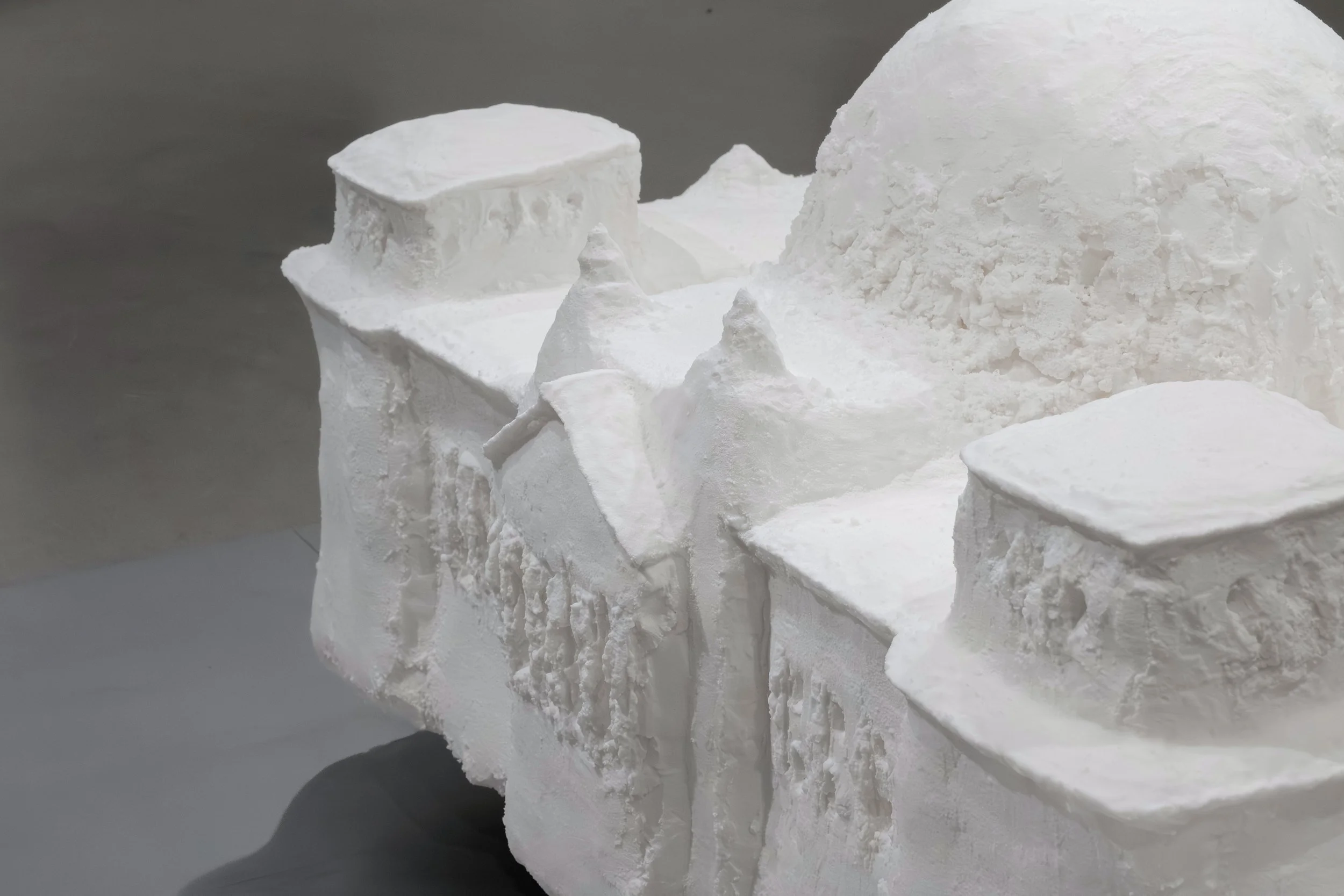
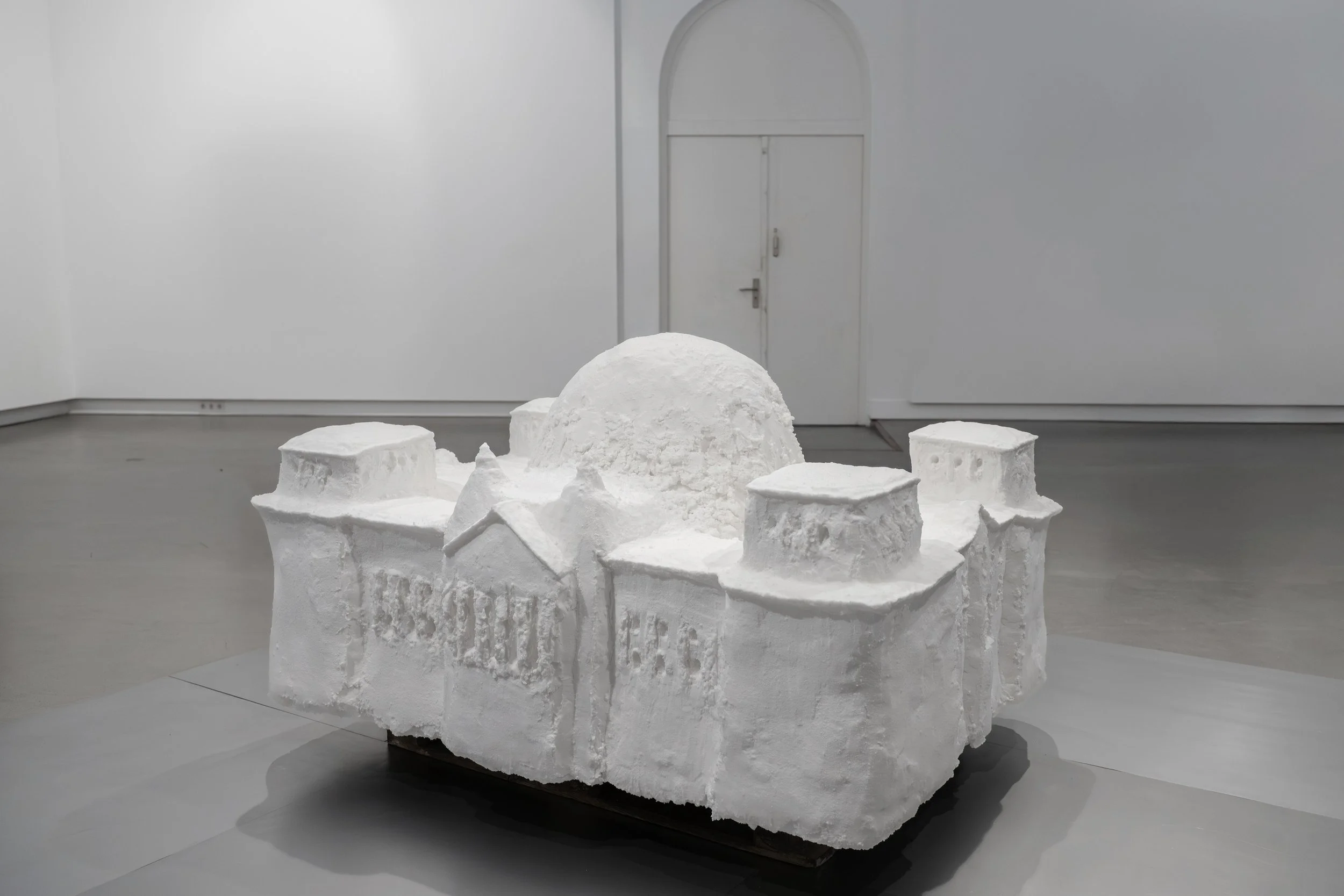
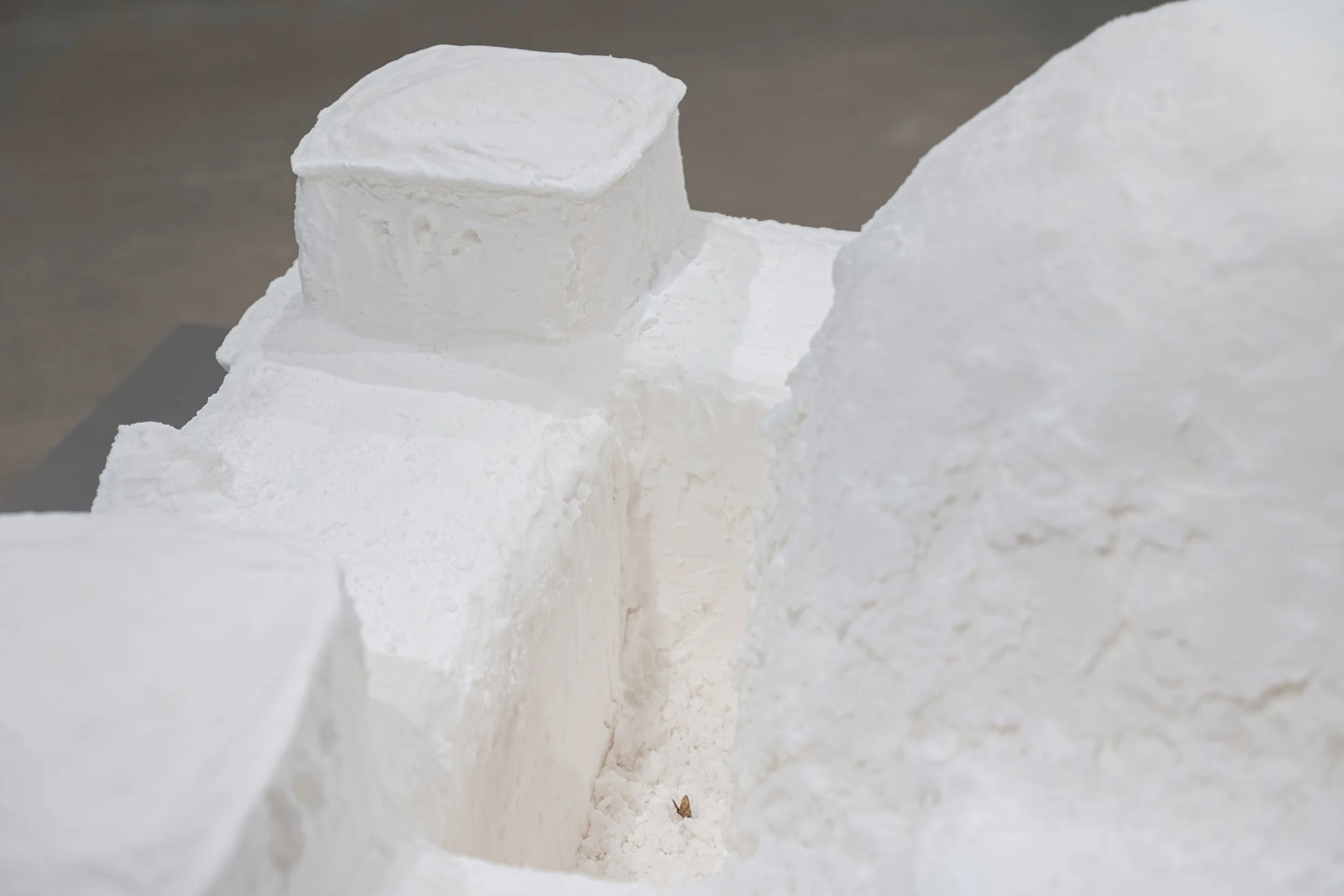
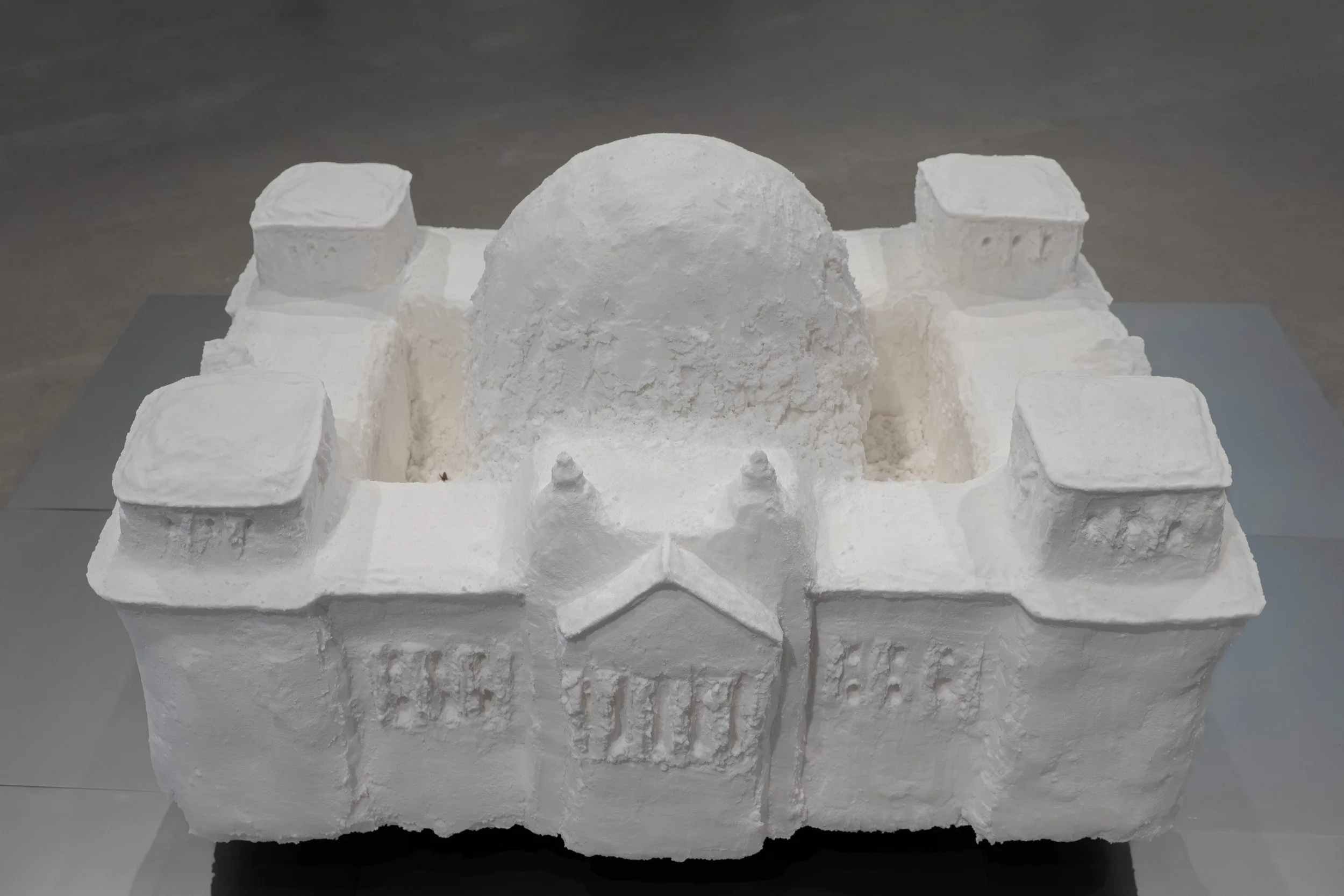
A sculptural rendering of the German Reichstag is constructed from approximately 375 kilograms of salt. Reduced to an outline, the building appears suspended between model and monument. Architectural details recede into a granular surface. The glass dome, designed as a symbol of democratic transparency becomes opaque. What remains is less a representation of a building than a shifting contour held in a fragile state of cohesion.
Salt functions here as both material and conceptional medium. Essential to biological life, it circulates through blood, sweat, tears, and urine while also operating as a preservative that arrests decay. It sustains and interrupts organic processes simultaneously. Highly soluble, it dissolves under moisture related environmental change, yet does not disappear, remaining dispersed within water systems and soils. Across cultural, religious, occult, and economic histories, salt has been associated with preservation, purification, value, and protection. Its crystalline structure has often been linked to ideas of order, clarity, and stability. At the same time, these associations intersect with histories in which concepts of purity have been mobilised politically: through narratives of national homogeneity, exclusion, and belonging or not belonging. In this context, the material proximity between salt’s visual whiteness, its capacity to preserve, and its tendency to form sediments or crusts opens onto ambivalent readings rather than fixed meaning.
The Reichstag, as an architectural site of successive political orders, functions as a projection surface for ideas of continuity and national self-representation. In its material translation into salt, these stabilising functions are rendered provisional. The sculpture remains exposed to environmental conditions; humidity, touch, and time continuously alter its surface. What appears solid is subject to gradual inherent dissolution.
Neither monument nor ruin, the sculpture occupies an intermediate state. It presents the Reichstag not as a stable symbol but as a structure already undergoing transformation. The work asks what societies attempt to preserve, what inevitably escapes preservation, and how political institutions negotiate the tension between continuity and change. Through the unstable materiality of salt, the Reichstag becomes less a representation of power than a meditation on its impermanence.
State of Affairs
2026
165 × 133 × 110 cm installed on 300 × 280 cm
Salt, potato starch, water, armature, blank steel, moth